EXIF Metadata After a Georgia Car Accident: Hidden Photo Data Can Help Prove Your Claim.
Video Chapters
- 00:00 Secret Photo Metadata Lawyers & Police Use
- 00:18 What Is EXIF Data? (Exchangeable Image File Format)
- 01:30 How GPS Metadata Helps Prove Car Accident Cases
- 02:48 Using Photo Timestamps to Reconstruct Events
- 03:59 Authenticating Photos for Court & Trial
- 04:30 Why Lawyers Demand Original Photo Files
- 06:13 Real Case Example: When Metadata Could Have Changed the Outcome
- 07:26 Why You Should Never Delete Original Accident Photos
Read Full Video Transcript
Welcome back to the Williams Elleby Howard & Easter YouTube channel. I'm Joel, and this is Jared.
Today we're discussing a little-known tool that law enforcement officers, insurance companies, and personal injury lawyers often use when investigating accidents: EXIF metadata, also known as Exchangeable Image File Format.
Most people have no idea that every photo they take with a smartphone or digital camera may contain hidden information that can help establish when, where, and how an event occurred. In many personal injury cases, that information can become critical evidence.
What Is EXIF Metadata?
Whenever you take a photo with an iPhone, Android phone, or most modern digital cameras, the image file often stores additional information behind the scenes.
This metadata can include:
- The exact date and time the photo was taken
- GPS coordinates showing the precise location
- The make and model of the device used
- Camera settings and technical image data
- Other identifying information that may help authenticate the photograph
In legal cases, this information can be incredibly valuable.
Real-World Example: GPS Location Data
Here's an example from my own life.
I was driving home from visiting my mother in South Georgia when my truck broke down just north of Columbus. While waiting at a rest area for my wife to pick up me and my dog, I snapped a picture.
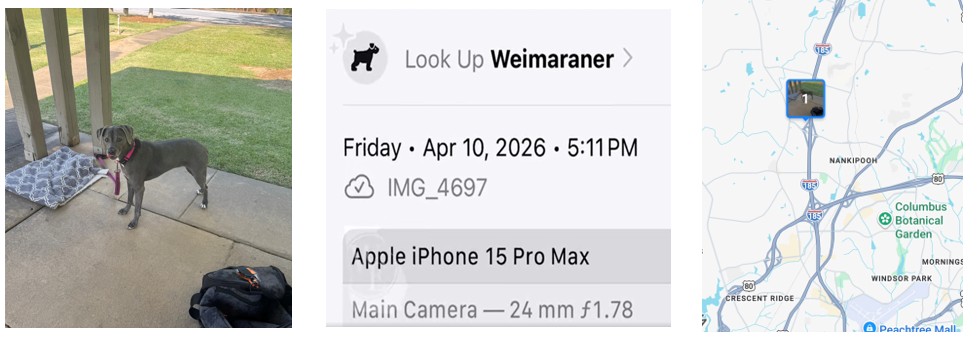
- The exact date and time the photo was taken
- The GPS location showing the rest stop
- The device used to capture the image
- Even an AI-generated description identifying my mixed-breed dog as a Weimaraner — which isn't exactly accurate!
The important takeaway is that the metadata precisely documents where I was at that moment.
Another Example: Community Event Photos
Here's another example.
This photo was taken with one of our paralegals, Hannah Smith, during a Touch-a-Truck event hosted by Kennesaw Parks & Recreation.
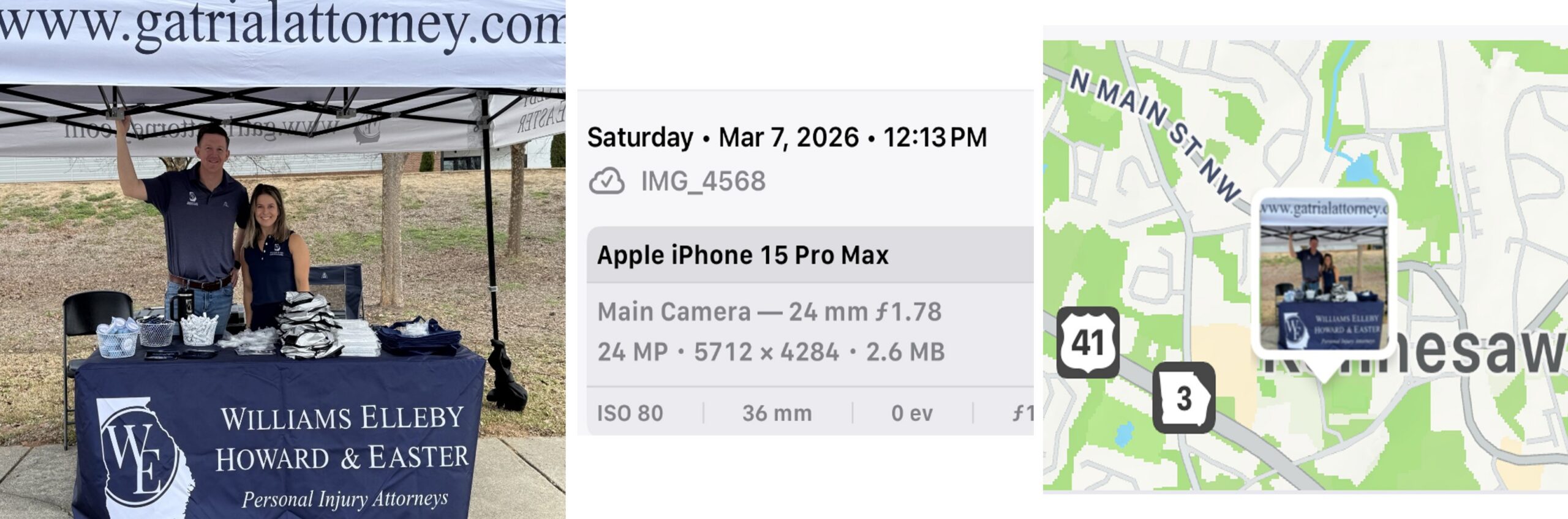
Again, the metadata tells us:
- Exactly where our booth was located
- The date and time the photo was taken
- The device used to capture it
That level of precision can become extremely important during an investigation.
Why EXIF Metadata Matters in Car Accident Cases
One of the biggest advantages of EXIF metadata is its GPS information.
Imagine a crash that happens on a winding rural road with dozens of similar curves.
Months later, investigators may need to revisit the exact crash location.
Instead of guessing which curve the collision occurred on, the GPS coordinates from the original photographs can pinpoint the exact location, saving significant time and eliminating uncertainty.
Establishing an Accurate Timeline
Metadata is also useful for reconstructing the sequence of events.
For example:
- A crash scene photo may show the collision occurred at 12:03 p.m.
- A hospital photo later that day may show the injured person already wearing a cast at 8:07 p.m.
- Medical records can then be compared against those timestamps to verify treatment timelines.
By comparing multiple sources of evidence, investigators can build a much more accurate picture of what happened.
Can Metadata Help Prove Intoxication?
Sometimes, yes.
Suppose someone spends the evening at a bar taking photos with friends.
The metadata may establish:
- The time those photos were taken
- Where they were taken
- The device used
If those photos show alcohol consumption shortly before a crash, investigators may compare those timestamps with the collision itself.
Metadata alone doesn't prove intoxication, but it can become one important piece of evidence when viewed alongside witness testimony, toxicology reports, surveillance footage, and other evidence.
Authenticating Photos for Court
Metadata can also help establish that a photograph is genuine.
It often identifies:
- The device used to capture the image
- When it was created
- Other technical information supporting its authenticity
That information may help attorneys satisfy evidentiary requirements when introducing photographs during trial.
Why Attorneys Want the Original Image Files
One mistake we frequently see is receiving printed photographs or PDF copies during discovery.
Those formats often strip away valuable metadata.
Whenever possible, attorneys should request the original digital image files, because that's where the EXIF metadata is stored.
Without the original file, important evidence may be lost.
Metadata During Discovery
Suppose there's reason to believe a driver was intoxicated before a collision.
An attorney may ask the court to order production of the original photographs taken during the hours leading up to the crash.
The goal isn't simply to view the images themselves—it may also be to examine their metadata.
In some cases, a judge may review those files before deciding whether they should be produced to the opposing party.
Metadata Can Resolve Close Cases
Sometimes even a single minute can matter.
I once handled a case involving a dispute over whether it was already dark when a collision occurred.
One driver claimed another vehicle didn't have its headlights on.
The question became whether sunset had already occurred.
We relied on 911 call records, police reports, and witness testimony, but detailed metadata from photographs could have provided additional evidence regarding the exact timing of the crash.
Cases like that illustrate why preserving original photographs is so important.
The Bottom Line
Whether you're:
- An injured person
- A personal injury attorney
- An insurance adjuster
- A law enforcement officer
Always try to preserve the original photo and video files whenever possible.
The hidden metadata inside those files may provide valuable evidence about:
- Time
- Location
- Device used
- Sequence of events
- Authentication
If privacy is a concern, most smartphones allow you to disable or remove location metadata before sharing photos. We won't cover those settings here, but they're available if you prefer not to share that information.
Final Thoughts
EXIF metadata is one of the most overlooked forms of digital evidence in personal injury investigations.
Understanding how it works can help preserve critical evidence and, in some cases, make the difference in proving what really happened.
If you found this video helpful, give it a thumbs up, subscribe to the Williams Elleby Howard & Easter YouTube channel, and explore our library of more than 300 videos covering personal injury law, car accidents, insurance claims, premises liability, medical malpractice, and practical legal tips designed to help protect you and your family.
Can Hidden Photo Data Help Prove Your Claim?
Quick answer: Yes. The original photo files on phones may contain EXIF metadata that helps show when and where pictures were taken, what device created them, and whether they fit the rest of the evidence. In a Georgia car accident claim, that hidden information can help identify the exact crash location, build a timeline, authenticate photographs, and answer an insurance company's claim that the pictures are unreliable. EXIF data rarely proves the entire case by itself, and it can disappear when a photo is screenshotted, edited, converted to a PDF, or downloaded from some apps. Preserve the original files before sharing or changing them.
A serious car wreck creates an evidence problem almost immediately. Vehicles are moved. Debris is cleared. Bruising develops over several days. By the time an insurance adjuster starts asking questions, the scene may no longer exist.
That is why the photographs from phones can be so important. The pictures show what the camera saw. The hidden data attached to the original file may help show where the camera was, when the picture was taken, and how the file was created.
We made the accompanying video because most injured people never think about this evidence until it has been stripped away. We have seen disputes turn on whether it was dark, which curve was involved, when an injury appeared, or whether a photograph came from the crash date. EXIF metadata can help answer those questions.
Key Takeaways
- EXIF metadata is information stored with many original digital photographs, including the date and time, GPS coordinates, device make and model, and camera settings.
- The most useful file is usually the original, full-resolution image, not a screenshot, social-media download, printed copy, or PDF.
- Metadata can help prove location, sequence, visibility, injury progression, and authenticity, but it should be compared with police records, 911 data, medical records, witnesses, video, and other evidence.
- Metadata is not automatically accurate or untouchable. Location services may be off, a phone clock may be wrong, and some fields can be edited. Context and preservation matter.
- After a crash, do not crop, filter, mark up, rename, delete, or selectively alter potentially relevant photographs. Keep the phone and make secure backups of the original files.
What Is EXIF Data?
EXIF definition: EXIF stands for Exchangeable image file format. It is a technical standard that allows a camera or smartphone to store descriptive information inside or alongside an image file. Think of it as a shipping label sewn into the photograph: the image is the package, while the label may identify when and where it was created and what equipment created it.
The Camera & Imaging Products Association's current Exif standard is Exif Version 3.1. The standard is detailed because digital cameras need a common way to describe images. An injured person does not need to understand the engineering. The practical point is simple: an original photograph may contain far more information than what appears on the screen.
Depending on the device, settings, file type, and software, EXIF fields may include:
| EXIF field or category | What it may show | Why it may matter in a crash claim |
|---|---|---|
| Date and time original | When the camera recorded the image | Helps build the crash, treatment, and injury timeline |
| Time-zone offset | The time zone connected to the timestamp | Helps avoid confusion when files move between systems |
| GPS latitude and longitude | Where the device estimated the photo was taken | Can identify the road, intersection, parking lot, or exact curve |
| Device make and model | The phone or camera that created the file | Can connect the image to a known device and support authentication |
| Software | The operating system or application associated with the file | May reveal that software processed or exported the image |
| Camera settings | Exposure, shutter speed, aperture, focal length, ISO, flash, and lens data | Can help explain why a scene looks brighter, darker, closer, or farther away than it did to the human eye |
| Orientation and dimensions | How the phone was held and the image's pixel size | Can identify rotation, resizing, or a lower-quality derivative copy |
| Embedded thumbnail and other tags | A preview and additional technical fields | Can sometimes help a forensic examiner compare versions of a file |
Not every photograph contains every field. GPS may be missing if the camera lacks location permission, and apps may remove metadata. Copying can also change ordinary computer "created" or "modified" dates even when EXIF fields remain. No single field should be used without context.
EXIF data is only one kind of metadata.
People often use "EXIF" and "metadata" as though they mean the same thing. They do not.
EXIF is one layer of image metadata. A file may also contain XMP or IPTC information, captions, editing history, cloud-library information, file-system dates, and data maintained by the application that stores the photograph. A phone may also create an AI label describing what it thinks is in the image. Those labels are not the same as camera-recorded EXIF fields.
We used a good example in the video. Joel took a picture while waiting at a rest area after his truck broke down north of Columbus. The stored information helped identify the location, date, time, and device. The phone's photo software also described his mixed-breed dog as a Weimaraner. It was close enough to sound plausible--but it was wrong.
That mistake matters. A machine-generated description is an interpretation. The GPS coordinates and timestamp are recorded data, although they still must be verified. Neither should be accepted blindly.
Photo metadata and video metadata are related, but not identical.
The word EXIF is most accurate when discussing still images. Videos commonly store technical information in a MOV, MP4, or QuickTime container instead. A Live Photo may involve both a still image and a short video file. For an injured person, the preservation rule is the same: keep the original photo and video files, including all paired components, rather than saving only what is visible on the screen.
Why EXIF Data Matters to Georgia Car Accident Victims.
The first fear many injured people have is that nobody will believe what happened. The second is that the insurance company will twist an incomplete record against them.
Those fears are not irrational. An adjuster may argue that a photograph was taken somewhere else, that bruising appeared much later, that a road condition did not exist, or that a picture was edited. The at-fault driver may give a different account. A witness may remember the wrong time. A police report may contain a location error. Months later, everyone is looking backward at an event that lasted only seconds.
EXIF data can give the investigation another fixed point. It does not replace testimony or common sense. It helps test them.
1. It can identify the exact crash location.
Consider a collision on a winding rural Georgia road with several similar curves. The police report may list a route and a nearby address, but an engineer or investigator later needs the exact place where the vehicles met. GPS coordinates from original scene photographs may point to the correct curve, shoulder, driveway, guardrail, or line of sight.
The same principle applies in a suburban area like Kennesaw, Georgia. A photograph near Cobb Parkway, Barrett Parkway, Cherokee Street, or I-75 may distinguish one entrance, lane, or signal from another. That can guide a search for sight-line evidence, surveillance video, and roadway records.
We also showed a local example in the video: a photograph taken at a Touch-a-Truck event hosted by Kennesaw Parks & Recreation. The image's metadata identified where and when the photograph was taken. In an accident investigation, that same type of location information may eliminate weeks of guessing.
GPS data is not perfect. It reflects the device's estimate and may be less accurate around buildings, trees, or weak signals. But even an imperfect coordinate can narrow the search dramatically.
2. It can establish a reliable sequence of events.
A crash case is often a timeline case.
Imagine that a scene photograph was recorded at 12:03 p.m. A second photograph at the emergency room shows swelling at 3:24 p.m. A later image shows the injured person in a cast at 8:07 p.m. Those times can be compared with the 911 call, ambulance run sheet, hospital registration, radiology study, and discharge paperwork.
When the sources line up, the timeline becomes harder to dismiss. When they do not, the mismatch tells the lawyer where to investigate.
This can be especially useful when an insurer claims the injured person delayed treatment or that a condition developed for unrelated reasons. Metadata does not give a medical diagnosis. It can help show that a visible injury and treatment occurred within a particular sequence following the collision.
3. It can document how injuries changed over time.
Some injuries are obvious at the scene. Others are not.
Bruising may darken over several days. Swelling can increase. A seat-belt mark, surgical incision, wound, rash, or mobility aid may look different from week to week. A series of original photographs can create a visual diary of recovery that is more meaningful than a single image taken months later.
The best practice is not to stage the pictures. Take clear, honest photographs in ordinary lighting. Preserve the originals. Keep a separate written note explaining what is shown and who took the photograph. Never change the date or location to make the file fit a preferred timeline.
These images may support claims involving pain, physical limits, scarring, and loss of normal activities. They help others understand an injury that is difficult to describe in words.
4. It can answer disputes about daylight, visibility, and conditions.
Our firm handled a case in which the parties disputed whether it was already dark when the collision occurred. One driver claimed the other vehicle did not have its headlights on. A one-minute difference near sunset could matter.
The lawyers had 911 records, the police report, and witness testimony but not original scene photographs. Detailed metadata from original scene photographs could have added another time reference. Camera settings might also have explained why a photograph appeared brighter or darker than the scene looked to a person standing there.
That last point is important. A modern phone automatically brightens dark scenes, combines exposures, and applies computational processing. A nighttime photograph that looks surprisingly clear does not prove that the road was well lit. Attorneys may need to compare the timestamp with official sunset data, weather records, streetlight evidence, and the camera's exposure settings.
5. It may help investigate alcohol use or distracted driving.
Suppose a driver spends the evening at a bar and appears in photographs shortly before a crash. The original files may help establish when and where those images were created. Investigators can compare that information with the crash time, receipts, surveillance video, witness statements, toxicology results, and phone records.
The same caution applies to distracted driving. A photograph or video created near the time of a wreck may be relevant, but the timestamp alone does not prove the driver was holding the phone at the moment of impact. The evidence must be connected to the driver, the device, and the collision.
Can EXIF metadata prove intoxication? Usually not by itself. A timestamped photograph showing a drink does not establish how much alcohol someone consumed, what was in the glass, or the person's blood-alcohol level. It may become one piece of a larger evidentiary picture.
The same caution applies to distracted driving. A photograph or video created near the time of a wreck may be relevant, but the timestamp alone does not prove the driver was holding the phone at the moment of impact. The evidence must be connected to the driver, the device, and the collision.
6. It can help authenticate a photograph.
In plain language, authentication means showing that the item is what the lawyer says it is.
Under O.C.G.A. § 24-9-901, Georgia's authentication requirement is satisfied by evidence sufficient to support a finding that the item is what its proponent claims. A witness with knowledge may authenticate a photograph, and the photograph's distinctive characteristics and surrounding circumstances may also matter.
EXIF data is not required every time a photograph is offered. A person who took the picture may simply testify that it fairly depicts the scene. But metadata becomes especially helpful when someone disputes the date, location, source, or originality of the image.
In a federal case, Federal Rule of Evidence 901 uses a similar basic test. Federal Rules 902(13) and 902(14) also provide paths for certain certified electronic records and data copied through a process of digital identification. One common method is a cryptographic hash--a long digital fingerprint that changes if the file changes. Those federal rules do not govern an ordinary Georgia state-court case, but they show why native files, sound forensic methods, and careful documentation matter.
7. It can help resist blame-shifting under Georgia Law.
Georgia follows a modified comparative-fault system under O.C.G.A. § 51-12-33. In general, an injured person's recovery may be reduced by the percentage of fault assigned to that person, and a person found 50% or more at fault generally cannot recover.
That gives an insurer a financial reason to argue that the injured driver was speeding, failed to keep a lookout, stopped in an unsafe place, or contributed to the wreck in some other way. A well-preserved set of photographs may show vehicle positions, debris, traffic controls, an obstructed sign, road construction, weather, or the absence of a claimed hazard. Metadata can help tie those images to the right place and time.
It is still only part of the proof. A photograph cannot calculate speed merely because it shows damage. It can preserve facts that an accident reconstructionist or other qualified witness later evaluates.
How EXIF Evidence Can Help an Injured Person Obtain Compensation
Compensation answer: EXIF data does not create damages and does not place a dollar value on an injury. It can strengthen the proof of fault, causation, injury progression, and credibility--the building blocks an injured person needs to recover compensation.
A Georgia car accident claim may include medical expenses, lost income, diminished earning ability, property damage, pain and suffering, scarring, disability, and future losses. In an appropriate case involving aggravated misconduct, punitive damages may also be considered. Each category requires proof.
Metadata can support that proof in several practical ways:
- It connects scene photographs to the road and time of the collision.
- It connects injury photographs to the hours and days following the wreck.
- It helps show that a series of images came from the same device and fits the medical timeline.
- It gives an attorney leads for finding cameras, witnesses, businesses, and road records near the exact location.
- It helps rebut accusations that photographs were created later or taken from another event.
- It preserves context for a mediator or jury that may not see the case until years after the road and vehicles have changed.
The Biggest Mistake: Saving Only a Screenshot, PDF, or Printed Photograph
A screenshot is a new picture of a picture. Its metadata generally describes when the screenshot was created--not when the original crash photograph was taken. A printed copy shows pixels on paper but does not carry the digital fields stored in the file. A PDF may preserve an image while stripping, changing, or hiding the original EXIF information.
Text messages, email, social platforms, and editing apps may resize images or remove metadata. The result varies by device, app, settings, and transfer method. "I texted it to myself" is not a complete preservation plan.
Whenever possible, give the lawyer the original digital file in its native format. Preserve the phone or camera that created it. If a copy must be made, choose an original, unmodified, or full-quality export and keep the master untouched.
Georgia discovery law allows parties to request photographs and other data compilations within the scope of discovery. O.C.G.A. § 9-11-34 specifically addresses the production and inspection of photographs and data compilations. A properly written request may seek the native image files and associated metadata, not merely a stack of printouts.
What to Do Immediately to Preserve EXIF and Other Photo Evidence
Your safety comes first. Move out of traffic if you can do so safely, call 911, and obtain medical care. Do not walk around an active highway or delay emergency treatment just to take pictures.
Once you are safe, follow these steps:
- Do not edit the originals. Avoid cropping, filters, markup, rotation, "enhance" features, date adjustments, location adjustments, or conversion to another format. Editing may create a new version or change relevant fields.
- Keep the original device. Do not trade in, reset, wipe, or discard the phone or camera while a serious claim is being investigated. Keep it charged and protected.
- Make two secure backups. Use a method that preserves original, full-resolution files. Keep one working copy and one backup in a separate secure location. When the stakes are high, ask an attorney or digital-forensics professional to guide the collection.
- Preserve related files together. Keep burst images, Live Photo components, videos, voice notes, and nearby photographs. The images immediately before and after the crash may help confirm the sequence.
- Do not rely on social media or text-message copies. Keep the version in the original photo library even if you send a copy to family, the insurer, or your lawyer.
- Create an evidence log without changing the files. In a separate document, note who took each group of photographs, what it shows, and any known transfer. Do not type the explanation into the image or overwrite its metadata.
- Identify every other source quickly. Ask passengers and witnesses to preserve their originals. Note nearby homes, stores, traffic cameras, dashcams, and commercial vehicles. Surveillance video is often overwritten within days or weeks.
- Do not selectively delete relevant material. Once a claim or lawsuit is reasonably anticipated, deleting or altering evidence can create serious problems. Preserve the complete, relevant set and let counsel decide what must be produced.
- Send evidence securely. Use the law firm's secure upload method or another method selected by counsel. Do not post crash or injury photographs publicly.
- Call a lawyer before the trail goes cold. A prompt preservation letter can request that a driver, trucking company, business, government entity, or other custodian retain relevant electronic evidence.
How to view photo information without changing it.
On a current iPhone, Apple explains that a user can open a photograph in Photos and swipe up or tap the information button to view the date, time, device, camera settings, filename, and location when available. Apple also allows users to adjust the date, time, and location, which is exactly why a visible screen is not conclusive proof that the data was never changed. The Apple iPhone photo-information guide explains those features.
Android menus vary by manufacturer and app, but most photo libraries have a "Details" or "Info" view. Looking is different from preserving. A serious dispute may require an examiner to collect the native file, document the method, calculate a hash, and compare the metadata with other records.
Preserve the private master before removing location information.
Location metadata creates a legitimate privacy concern. A publicly shared photograph may reveal a home, school, workplace, or routine. Apple and other platforms provide tools to remove location information from a shared copy.
For evidence, reverse the order most privacy articles recommend: first preserve the untouched master file in a secure place; then create a separate privacy-safe copy for public or nonlegal use. Never remove or change data from the only copy of a potentially important crash photograph.
Georgia Venue: Where a Georgia Car Accident Case May Be Filed
Venue answer: In Georgia, most conventional negligence lawsuits against an individual are filed in the county where the at-fault person resides. In many cases, that means the State or Superior Court. Both handle civil lawsuits.
The Georgia Constitution generally provides that civil cases are tried in the county where the defendant resides. Venue becomes more complicated when a commercial vehicle, corporate employer, multiple defendants, a nonresident driver, a government body, or an uninsured-motorist carrier is involved. For example, O.C.G.A. § 40-12-3 provides special venue choices for actions involving nonresident motorists.
This is another reason exact location evidence can matter. The place of the collision may help determine the proper forum for a nonresident defendant, identify the law-enforcement agency, and point counsel toward the right traffic, roadway, and emergency-response records. EXIF coordinates do not decide venue by themselves; they can help establish a fact used in the venue analysis.
Georgia Deadlines Make Early Preservation Essential
Georgia's statute of limitation for most personal-injury claims is two years under O.C.G.A. § 9-3-33. That does not mean an injured person should wait two years. Claims involving government vehicles or public entities may require much earlier notice, and other exceptions can shorten or change the deadline.
Digital evidence usually disappears long before the statute expires. A business may overwrite surveillance video. A vehicle may be repaired or sold. A phone may be traded in. A social-media account may change. The best time to preserve evidence is measured in days, not years.
How We Evaluate EXIF Evidence in a Georgia Car Accident Case
We begin with the question the evidence must answer: Is location disputed? Is the insurer challenging the treatment timeline or visibility? Did the other driver create photographs or video near the time of the wreck?
From there, the work may include:
- collecting native files from the client and witnesses;
- documenting the device, file names, file types, and collection method;
- calculating digital hashes to identify exact copies;
- comparing EXIF and other metadata with 911 calls, police body-camera footage, crash reports, medical records, receipts, weather, sunset, and surveillance video;
- sending preservation letters and targeted discovery requests;
- using a qualified digital-forensics professional when authenticity or alteration is genuinely disputed; and
- presenting the evidence in a simple way that a claims professional, mediator, judge, or jury can understand.
The goal is simple: use technology to answer a human question--what actually happened?
Why Georgia Car Accident Victims Choose Williams Elleby Howard & Easter
Williams Elleby Howard & Easter is a Kennesaw-based personal injury law firm that represents people injured in car wrecks and other serious incidents throughout Georgia. Our lawyers investigate cases with trial in mind, because evidence gathered early often determines what can be proved later.

Joel Williams is the firm's managing partner. He has been recognized by Georgia Super Lawyers, has served in leadership with the Cobb County Trial Lawyers Association, and regularly teaches and writes about trial practice. His background in Southwest Georgia and practice in metro Atlanta gives him practical experience with cases arising on both crowded urban roads and rural highways.
Jared Easter is a partner who has represented injured people throughout his legal career. He has practiced in Georgia since 2012 and is admitted in Georgia's trial courts, the Georgia Court of Appeals, and the United States District Court for the Northern District of Georgia.
Our team brings more than 75 years of combined experience. The firm's published case results reflect more than $110 million recovered in prior matters. Past results do not guarantee a similar outcome, but they show why we take evidence and trial preparation seriously.
Clients also choose us because they want direct answers. We explain what the evidence proves, what it does not prove, and what still needs to be found. For more practical guidance, visit our personal injury video tips and our guide to hiring a Kennesaw car accident lawyer.
Injured in a Georgia Car Accident? Preserve the Original Photographs Now
The insurance company may already be collecting photographs, statements, vehicle data, and social-media information. You should not assume it will preserve evidence that helps you.
Before you crop a picture, replace your phone, send the only copy by text, or accept an insurance offer, speak with a lawyer who understands both the legal claim and the digital evidence. We can review the available files, identify what is missing, and move quickly to preserve evidence held by other people or companies.
Call Williams Elleby Howard & Easter at (404) 389-1035 or use our online contact form to request a free consultation. There is no upfront attorney's fee, and we do not charge an attorney's fee unless we recover compensation for you.
Frequently Asked Questions About EXIF Data and Georgia Car Accident Claims
We know you have many questions right now. Below are answers to some of the common concerns we hear from car accident victims and their families.
Does every phone photograph contain GPS coordinates?
No. GPS information may be missing if location services were turned off, the camera lacked permission, the device could not determine a location, or an app removed the data. A missing GPS field does not mean the photograph is fake.
Is the date shown in my Photos app always correct?
Not necessarily. A phone generally uses its system clock, and modern photo apps may allow a user to adjust the displayed date, time, or location. Lawyers compare the file with other records rather than treating one screen as unquestionable proof.
Can EXIF data be changed?
Yes. Some fields can be edited intentionally, and metadata can also change during ordinary copying, exporting, or processing. That is why the original device, native file, transfer history, digital hash, and surrounding evidence may all matter.
Does taking a screenshot preserve the original metadata?
Usually not. A screenshot creates a new image whose time and device information generally describe the screenshot, not the original crash photograph. Keep the original file even when you make a screenshot for convenience.
Will texting or emailing a photograph remove EXIF data?
It depends on the application, settings, and transfer method. Some services resize the image or strip metadata; others preserve more of it. Do not use a texted or emailed copy as the only preserved version.
Can EXIF data prove where a crash happened?
GPS coordinates can strongly support a location, especially when they match the visible scene, police report, 911 data, and witness testimony. GPS is a device estimate, however, and its precision varies. It should be verified, not treated as infallible.
Can EXIF metadata prove the other driver was drunk?
Metadata alone rarely proves intoxication. It may connect photographs to a bar and time shortly before a crash, but investigators still need evidence such as toxicology, receipts, witnesses, surveillance, admissions, or driving behavior.
Do I need EXIF data for my photographs to be used in court?
No. Georgia law allows several ways to authenticate evidence, including testimony from a witness with knowledge. EXIF data can become especially valuable when the other side disputes when, where, or how a photograph was created.
What should I send my lawyer?
Send the original, full-resolution photo and video files through the method your lawyer requests, and keep the original device. Also identify who took the files, what each group shows, whether anything was edited, and how any copies were transferred.
Can my lawyer obtain original photographs from the at-fault driver?
Possibly. Once a lawsuit is filed, targeted discovery may seek native photographs and associated metadata that are relevant and proportional to the issues. Before suit, a preservation letter can put the driver or another custodian on notice not to destroy relevant evidence.
Where would a lawsuit be filed if the at-fault driver lives in Kennesaw?
A conventional claim against a Kennesaw resident would usually have venue in Cobb County, and the State Court of Cobb County is often the court used for a car-accident damages case. The answer can change with corporate defendants, nonresident drivers, multiple defendants, government entities, and other facts, so counsel should analyze venue individually.
How long do I have to file a Georgia car accident claim?
Georgia generally allows two years for a personal-injury action, but some claims have earlier notice requirements or different deadlines. Evidence can disappear within days, so the filing deadline should never be treated as a reason to delay preservation or legal advice.
Should I remove location data before posting a crash photo online?
The safer choice is usually not to post claim-related photographs at all. Preserve the untouched master privately first; then, for a genuinely necessary public use, work from a separate copy with sensitive location information removed.
Final Word
A photograph can freeze a moment. EXIF metadata may preserve its coordinates, clock, device, and technical context. It will not replace a careful investigation, but it can make one more accurate when location, timing, or authenticity is disputed.
After a Georgia car accident, keep the originals. Keep the device. Avoid edits. Make secure backups. Then let an experienced lawyer decide how the data fits with the rest of the evidence.
This article is general information, not legal advice. Reading it does not create an attorney-client relationship. Laws, court rules, technology, and filing deadlines can change, and every case depends on its own facts.
Contact Williams Elleby Howard & Easter today at (404) 389-1035 or through our online form for your free case evaluation.