Deciding to move a beloved family member to a nursing home or assisted living facility is one of the most difficult choices a family can make. You spend countless hours researching, touring facilities, and asking questions, all to find a safe, caring, and respectful environment. But what if you suspect they have been injured or neglected in that facility? An experienced Kennesaw, GA, nursing home neglect lawyer can be your family's strongest advocate to protect your loved one.

If you think a nursing home hurt someone in your family, the fastest way to find out is to read the chart. Georgia facilities have to keep records of the care they give, and those records usually tell you more than the staff will. Two separate claims may be available. One is an ordinary negligence or malpractice claim for the harm itself. The other comes from the Bill of Rights for Residents of Long-Term Care Facilities, which lets a resident sue a facility for violating rights the statute grants. The deadlines are short, and they aren’t the same for every claim.
When a resident suffers harm, the blame often extends far beyond a single negligent caregiver. Nursing home abuse and neglect are frequently symptoms of a deeper, systemic problem within the facility or its parent corporation. A thorough investigation is necessary to identify every party whose decisions contributed to your loved one’s suffering. Our goal is to hold all responsible parties accountable.
The dedicated team at Williams Elleby Howard & Easter is committed to protecting our community's most vulnerable residents. If you suspect nursing home abuse or neglect, contact us today for a free, confidential, and compassionate consultation.
What counts as nursing home abuse or neglect in Georgia?
Abuse is what someone does to a resident. Neglect is what nobody did for them. Both can support a claim, and in my experience neglect cases are far more common than the deliberate cruelty people picture when they hear the word abuse.
Here are the categories I see most often:
- Neglect. Not enough food or water, missed medications, no repositioning, unattended call lights, falls in a resident already known to be a fall risk. Pressure ulcers, dehydration, malnutrition, and urinary tract infections are common results.
- Physical abuse. Hitting, rough handling, or improper physical restraint.
- Emotional or psychological abuse. Threats, humiliation, or cutting a resident off from family.
- Financial exploitation. Taking money or property, or steering a resident into signing something.
- Sexual abuse. A crime, and a basis for a civil claim.
Video Chapters
- 00:00 Introduction: Nursing Home Injuries and Legal Rights
- 00:30 Types of Nursing Homes and Long-Term Care Facilities
- 00:58 Federal and Georgia Nursing Home Regulations
- 01:30 Who Is Liable for Nursing Home Injuries?
- 02:25 Identifying the Responsible Corporate Entity
- 03:03 Medical Directors and Outside Physicians
- 03:35 Common Causes of Nursing Home Injuries
- 04:45 When Is an Expert Witness Required?
- 05:33 Medication Errors: Professional vs. Ordinary Negligence
- 06:30 Malnutrition and Dehydration in Nursing Homes
- 07:01 Understanding Nursing Home Arbitration Clauses
- 08:10 Are Nursing Home Arbitration Clauses Enforceable?
- 08:56 Key Factors in a Nursing Home Negligence Case
- 10:18 What to Know Before Choosing a Nursing Home
Read Full Video Transcript
Medical Malpractice Cases Involving Nursing Homes
Nursing home, long-term care facilities and injured loved ones. Hi, I'm Joel. This is Marc. Welcome back to the Williams Elleby Howard & Easter YouTube channel. Today, that's what we're going to be talking about and we're going to start by talking about why it matters as to the kind of facility that your loved one may be in and what different laws may apply to those facilities.
Different Types of Nursing Homes and Long-Term Care Facilities
So, Marc, you want to get us started with that?
Sure. So, one of the first things anyone should know about a nursing home is that there are actually different levels of nursing homes, it could be an assisted living center, it could be what's called a skilled nursing facility. In Georgia, there are different layers of these and one is called a personal care home and the level of regulation that the federal government or the state puts on these different facilities depends on the level of care that needs to be provided.
Right. And when you're looking at the laws that apply and what regulations each facility has to adhere to you have federal regulations, you also have state regulations and those state regulations may vary according to what state you're in so it's really important to know depending on what kind of case you have or what happened to your loved one what the laws are for your particular state which means as we always say find a good lawyer that's experienced with nursing home cases in your state so you'll be a step ahead of the game when you get started.
Identifying Responsible Parties
One thing that I think is really important in any kind of assisted living case is being able to identify who the correct defendant is. In other words, who is responsible for the thing that happened to your loved one and not just who did it, but who is legally responsible for paying damages according to what happened. So, in nursing home cases or even assisted living facilities it can be just a nightmare trying to figure out exactly who the corporate defendant is, but there are certain ways that you can go about figuring out exactly who is responsible and I think one of the first places you would look would be the contract you signed with the nursing home or the assisted living facility to see who the corporate entities are and who employs the people that did something or failed to do something to hurt their patient.
That's exactly right. And one of the first things someone should look at is the contract because when you go into a nursing home or any personal care home assisted living you sign a contract and it should have the corporate name at the bottom another way of doing that is I like to send, in Georgia it's called an Open Records Act request, it could be called a Freedom of Information Act request to the state and ask for information about the facility located at such and such an address and typically it will come back and it might give you filing paperwork that the corporation did with the state that then shows you what the corporate entity is.
One other red flag that you got to be concerned about is if medical care is one of the issues, not just nursing care, oftentimes medical directors of these facilities are outside doctors who have their own contract with the corporation and so it may be that if the doctor did something wrong in doing a plan of care or not ordering correct medication or whatever you may be having to look to an entirely different entity.
Common Types of Nursing Home Injuries
That's right. And depending on what happens it could be different like Marc was saying it could be doctors, their physicians group, it could be nurses that are employed by the nursing home or assisted living facility, but when we're looking at these long-term care facilities and the things that can happen the ways that patients could be harmed, it's as broad as the sea, you could have things like assaults physical or sexual, bedsores, infections, falls, malnutrition, dehydration, wandering if somebody's got a mental defect and they're allowed to wander and are not properly supervised, you could have things like medication errors all of these different things could happen and there are different people within the facility that have the responsibility to monitor things and do things to prevent something bad like that from happening so for example if it's a medication error there may be a doctor who issues the orders for certain medication, but then someone else either a med tech or sometimes nursing homes will have individuals whose only job is to administer medication and they could mess that up, right, and so there's not really discretion there which leads us to another topic, is when do you need an expert witness for a nursing home case?
Professional Negligence and Expert Witnesses
Yeah. So, Georgia has a rule that anytime you have a claim that's based on professional services that requires professional skill and care it's considered to be a professional negligence or malpractice case and in that type of situation you have to have an expert even in Georgia to get in the courthouse door you have to have an affidavit signed by an expert who says there was negligence and they have to actually identify the caregiver or the type of caregiver that committed the negligence that's not always the case there are things that happen in a nursing home that might not involve professional care and skill and it's called ordinary negligence and you have to be able to know which is which.
Medication Errors
Yeah, a good example of that might be the medication error that we were talking about earlier so the doctor may have discretion as to what types of medication to prescribe and the doctor may prescribe the exact right correct medication that the patient needs, but then the person who's administering the medication may give patient A's medication to Patient B and then Patient B is seriously harmed because they take the wrong medication, there's no discretion there when the doctor says give medications A, B, C, and D, give it in this amount, give it three times a day at these times then the person who's administering the medication has to follow the doctor's orders so the doctor has the discretion, but the tech or the nurse is just following those orders so arguably I'm sure the defense may have a different opinion on this sometimes, but arguably there's no professional discretion there, you're just doing what you're told.
Nutrition and Hydration
Sure, another good example of that might be nutrition because a doctor may say make sure there's adequate nutrition intake enough fluids for someone to be able to stay hydrated, but then the person who's serving the meal may place the food or the liquid in front of someone who's incapable of feeding themselves and they may sit there and starve with food sitting right in front of them, that's not necessarily something that requires professional skill, it's simply a matter of making sure that they feed themselves.
Arbitration Clauses
Yep. So, when you're dealing with a situation where a loved one or yourself is hurt badly in a nursing facility or a long-term care facility one of the biggest challenges that we run into, what we call arbitration clauses, and arbitration clauses are written into contracts when you get ready to admit someone to the facility that basically waives your right to a jury trial and instead of going to a court of law and hashing out the dispute about who's at fault you would go to an arbitration where there may be a panel of three arbitrators or one arbitrator depending on how it's written up and then the case is essentially tried in this alternate forum as opposed to the courthouse now generally the nursing homes are going to want to do arbitration because they will say we're going to use this company to do the arbitration and instead of you know going to court and having a jury trial there are many reasons they want to do that, but it is a challenge in these cases as to figuring out whether that arbitration clause that's written into the contract is even enforceable so there are several things that we would look at to determine whether they're enforceable or not, you want to go over a couple of those?
When an Arbitration Clause May Be Enforceable
Sure, like one of the big ones is is the person who signed the contract did they have the right to sign an arbitration clause because sometimes a person who's entering a nursing home may have a loved one or somebody else sign the contract for them and that person may or may not have a power of attorney on behalf of that person to sign the contract another thing is whether the contract was presented in such a way that it was fair was it you know tiny print that no one could read was there sufficient language in there to let people know what they were signing did a person have mental capacity to sign a contract those are all things that you look at to find out whether the clause can be enforced.
Important Considerations in Nursing Home Cases
Yep. So, all in all when someone is injured in a long-term care facility no matter what the injury is some of the most important things that you're going to need to look at are what type of facility it is so you can figure out which regulations apply you're going to need to figure out who the individuals and corporate entities are that could potentially be responsible for the damage, you're going to need to figure out okay how was the person hurt and how do we prove "link it up" and say they were hurt due to what error and what breach of the standard of care or what ordinary negligence led to those injuries and then you have to figure out what forum to bring the claim in, is it going to be arbitration, is it going to be a traditional lawsuit, but there are a lot of things and subspecialties that have formed in the law dealing with nursing home and long-term care facility cases so when you have the unfortunate situation where you or a loved one is hurt in one of these facilities then it's going to be really important to find a lawyer with experience handling those types of cases because the rules are not the same as they are in a regular car wreck case or slip and fall case.
Correct. If a lawyer takes a nursing home case and doesn't even know the regulations that might apply to that home then they're going to be missing a whole lot of potential avenues to pursue the case.
Advice for Families Considering a Nursing Home
That's right, all right well anything else you can think of on nursing home cases?
No, the only thing I can think of is if you're thinking of sending someone, a loved one, to a nursing home is make sure you read the contract you don't have to sign that arbitration clause and make sure you do some research on Medicare's website to see if there have been problems in the past.
Yep, all right well we hope this video has been helpful to you, if so give us a thumbs up, hit that subscribe button and we will see you next week.
Meet the Attorneys: Joel Williams and Marc Howard

Attorney Joel Williams is an experieced Georgia personal injury trial attorney who represents individuals and families harmed by negligence. He is dedicated to helping injured clients understand their legal rights and pursue accountability.

Attorney Marc Howard is a Georgia trial attorney who handles complex personal injury and medical malpractice cases. His work includes investigating negligent medical care and helping families seek justice when healthcare providers fail to meet appropriate standards of care.
Meet the Attorneys: Joel Williams and Marc Howard
Attorney Joel Williams is an experieced Georgia personal injury trial attorney who represents individuals and families harmed by negligence. He is dedicated to helping injured clients understand their legal rights and pursue accountability.
Attorney Marc Howard is a Georgia trial attorney who handles complex personal injury and medical malpractice cases. His work includes investigating negligent medical care and helping families seek justice when healthcare providers fail to meet appropriate standards of care.
Where is the line between a bad outcome and neglect?
Elderly and sick people decline, and some of what happens in a nursing home would have happened anywhere. That’s the facility’s main defense, and sometimes it’s right. The question isn’t whether your family member got worse. It’s whether the facility did what the standard of care and its own care plan required, and whether the failure caused the harm.
Why does the nursing home medical chart matter more than what the facility tells you?
Because staff wrote the chart before anyone was thinking about a lawsuit. They document as they go, for clinical and regulatory reasons. Afterward, people who already know something went wrong filter what the family hears.
Nursing home records also reveal more than most people expect. A facility claiming it turned a resident every two hours has to have something showing it. If a facility says the wound was there on admission, it should have a skin assessment from the day she arrived. Gaps in a record are evidence too.
Which nursing home records matter most?
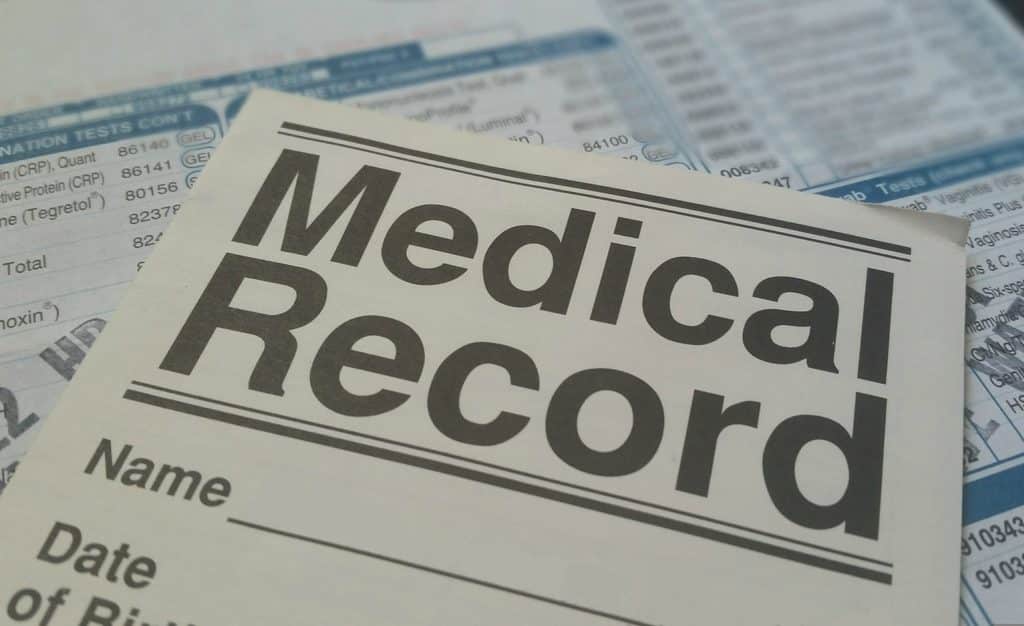
- The care plan, and every revision to it. This is the facility’s own statement of what this resident needed.
- Nursing notes and treatment administration records, including turn and repositioning documentation.
- The medication administration record, or MAR, which is the running log of which drug staff gave, at what dose, and when.
- Skin assessments and wound measurements over time, with photographs if any exist.
- Weight and intake records. Steady weight loss over months is hard to explain away.
- Fall and incident reports, and the post-fall assessments.
- Staffing and assignment sheets for the shifts in question.
- State survey and inspection history for the facility.
Surveyors inspect Medicare-certified facilities, and the results are public. You can look up a facility’s inspection results, staffing data, and quality measures at Medicare Care Compare. Georgia’s own inspection and complaint records sit with the Healthcare Facility Regulation Division of the Georgia Department of Community Health.
The first nursing home case I ever handled involved the failure to give a diabetic resident a 39-cent serving of orange juice. His blood sugar dropped very low, and he died. The chart showed the facility repeatedly failed to feed him according to his plan of care. We then uncovered a company-wide policy of cutting snacks to save money and increase corporate profits. It all started when we noticed a certified nursing assistant, or CNA, hadn’t charted the orange juice the resident’s physician ordered.
How does a family get all records from a nursing home facility?
A resident, or the person holding a valid power of attorney or serving as guardian, can request the chart directly from the facility. After a death, the personal representative of the estate can request it. Ask in writing, ask for the complete record rather than a summary, and keep a copy of the request. Facilities can charge for copies.
Ask early. Records are easier to get before a dispute hardens, and staff turn over.
Is a nursing home case ordinary negligence or medical malpractice?
This sounds like a technicality and it isn’t. It decides two things, and either one can end a case before anyone looks at the merits: whether an expert affidavit has to accompany the complaint, and which filing deadline applies.
In an action for damages alleging professional malpractice, Georgia requires the plaintiff to file with the complaint an affidavit of an expert competent to testify, setting out at least one negligent act or omission and the factual basis for the claim. That is O.C.G.A. § 9-11-9.1. The statute lists the professions it covers, and nurses are on the list.
So the same facts can go two ways. A claim an aide dropped a resident while moving her may be ordinary negligence. A claim a nurse misread a wound assessment and failed to escalate it involves professional judgment, and it needs the affidavit.
Georgia courts sort this out claim by claim, and the line is contested. I wouldn’t assume either answer. You file the case right or you file it fatally short, and the front end is where the difference gets settled.
How long do you have to file a nursing home case in Georgia?
Short answer: usually two years, sometimes less than you think, and occasionally the clock is already running on something you haven’t discovered yet. It also matters whether your family member, or someone acting for them, signed an arbitration agreement. One of those can push the whole dispute out of court and into private arbitration.
For injuries to the person generally, O.C.G.A. § 9-3-33 requires suit within two years after the right of action accrues. As a general rule the clock starts on the date of the injury, and in a wrongful death case on the date of death.
For medical malpractice, O.C.G.A. § 9-3-71 requires suit within two years after the date the injury or death occurred, and it sets an outer limit: in no event more than five years after the negligent act or omission. Subsection (c) says it plainly. The two years is a statute of limitations, and the five years is a statute of ultimate repose and abrogation. Repose is different from a limitations period. It can cut off a claim nobody has discovered yet.
Wrongful death and the estate’s separate claim for medical and funeral expenses carry their own timing questions, and so do claims involving a resident who lacked capacity. Those rules have exceptions layered on exceptions.
If a facility hurt someone in your family, get the date checked by a lawyer now rather than after you’ve finished grieving. Missing a filing deadline is the one mistake here nobody can fix.
What does the Georgia Bill of Rights for Residents of Long-Term Care Facilities add?

Most articles about nursing home cases never mention it. Georgia has a statutory bill of rights for residents of long-term care facilities at O.C.G.A. § 31-8-100 et seq. It grants residents specific rights: to care and treatment, to privacy, to freedom from unnecessary restraint or isolation, to manage their own money, to keep and use their own property, to have visitors, and to complain without retaliation.
It also has teeth. Under O.C.G.A. § 31-8-126, a person aggrieved because a facility violated or failed to provide a right granted under the article has a cause of action against the facility for damages and such other relief as the court deems proper, and failure to exhaust administrative remedies doesn’t bar the action.
That matters for a practical reason. Some plainly wrong conduct is hard to package as a personal injury claim. A facility isolating a resident from her children, or refusing to account for her money, may not have caused a broken bone. The bill of rights gives the conduct a name and a remedy.
What about the arbitration agreement in the nursing home admission packet?
Many admission packets include an agreement to arbitrate, which means giving up the right to a jury and having the dispute decided privately instead. Families sign these in a stack of paperwork on the worst day of the year, and almost nobody reads them.
Whether the agreement actually binds anyone is a real fight, and the answer turns on facts: who signed, whether the signer had legal authority to sign for the resident, whether signing was a condition of admission, and what the document says. I wouldn’t assume a signed arbitration agreement ends the matter, and I wouldn’t assume it doesn’t.
Find the admission packet. It’s one of the first things I want to see.
What damages can a family recover from a nursing home abuse claim?
Georgia divides damages into categories. They sound abstract until you price them out for a real person.
- Economic damages. Medical bills tied to the harm, hospitalization, wound care, rehabilitation, and the cost of moving a resident to a safer facility.
- Non-economic damages. Physical pain, mental suffering, and the loss of the things a person could still do before this happened.
- Punitive damages, in cases where the conduct goes beyond negligence. Georgia limits these, and the standard of proof is higher.
- Disability and Disfigurement. For permanent harm, such as scarring from bedsores or a permanent impairment from a fall.
- Wrongful death. Where a resident died, Georgia recognizes a claim for the full value of the life of the decedent, brought by the survivors identified in O.C.G.A. § 51-4-1 et seq. The estate has a separate claim under O.C.G.A. § 51-4-5 for medical and funeral expenses and for the pain and suffering the person went through before death.
I’ll say one thing plainly, because families ask and deserve a straight answer. In Georgia the full value of the life of an elderly person is a real claim, but the economic piece is usually small. The value of these cases lives in the human part, and you prove the human part with witnesses and records. You don’t assert it.
Many nursing homes and their lawyers don’t put much value on the life of an elderly person who was already sick and had limited time. But in my experience, juries see it differently.
I tried a case years ago involving an elderly woman already on hospice with only weeks to live, and she died earlier because of malpractice. We settled while the jury was deliberating. When I talked to the jurors afterward, they told me they had been discussing a very large verdict, because the woman had been deprived of the chance to say goodbye to her loved ones and to die with dignity. They believed giving her that opportunity was the nursing home’s job. It’s what they got paid to do.
What should you do this week if you suspect nursing home neglect?
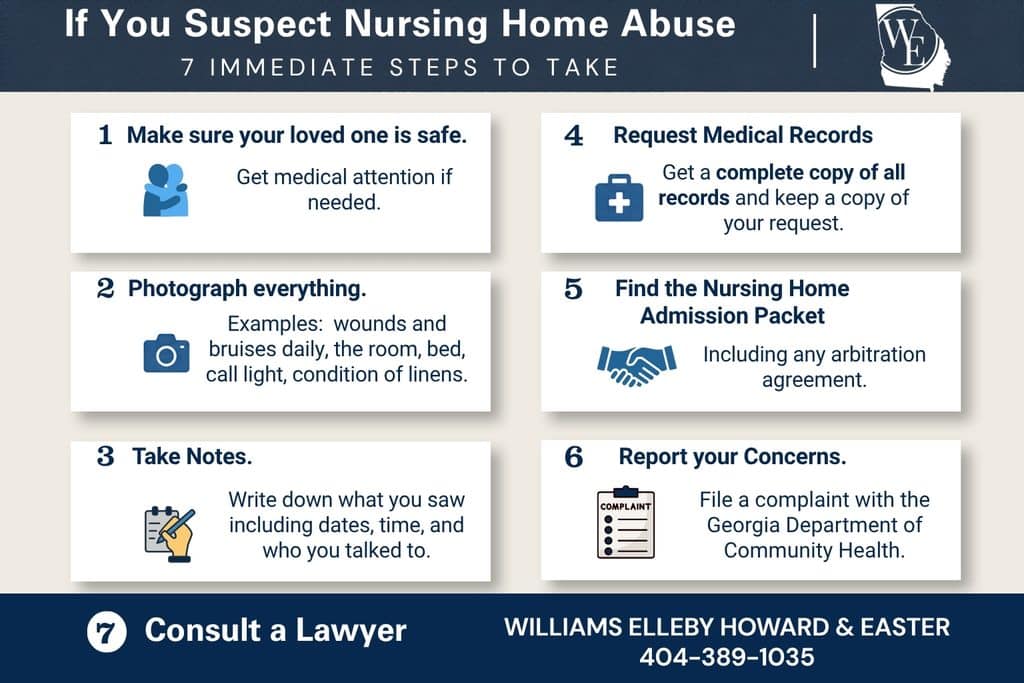
- Make sure the person is safe. If they need care now, get them care now.
- Photograph everything. Wounds, bruises, the room, the bed, the call light, the condition of the linens. Photograph again in a few days, because wounds change.
- Write down what you saw and who told you what, with dates. Memory fades fast and you’ll need this.
- Request the complete medical record in writing. Keep a copy of the request.
- Find the admission packet, including any arbitration agreement.
- Report your concerns. The Georgia Long-Term Care Ombudsman Program advocates for residents and investigates complaints, and you can file a complaint about a licensed facility with the Healthcare Facility Regulation Division of the Georgia Department of Community Health. Reporting creates an official record, and an investigation can produce documents you wouldn’t otherwise see.
- Be careful what you sign, and be careful what you say to the facility’s risk manager or its insurer. Someone writes those conversations down.
Why Choose Williams Elleby Howard & Easter for Your Nursing Home Case
Choosing a law firm to handle a case of this magnitude and sensitivity is a critical decision. You need a team that not only possesses deep legal knowledge but also demonstrates genuine compassion for what your family is going through. Nursing homes and their corporate owners are defended by aggressive law firms and insurance companies; you need an equally powerful team on your side. While no amount of money can erase the harm and betrayal your loved one has experienced, a successful lawsuit can provide the financial resources needed for their care and can deliver a powerful measure of justice.
Here’s why families in Kennesaw trust us to be their advocates:
- We Understand the Unique Laws: Nursing home litigation is a complicated area of law. We have a thorough understanding of the federal and state regulations that govern long-term care facilities, as well as the Georgia Residents' Bill of Rights. We use this knowledge to expose violations and build a strong case.
- We Have the Resources to Fight Corporations: These are not simple cases. They often require extensive investigation, detailed review of thousands of pages of medical and facility records, and testimony from medical and nursing home administration professionals. We have the financial resources and professional network to take on the largest healthcare corporations.
- We Are Compassionate Allies: We know that this is an emotional and difficult journey. We treat every client with the dignity, respect, and personal attention they deserve. We listen to your story, explain your options in clear terms, and support you every step of the way.
- We Are Committed to Accountability: Our goal is more than just securing a financial settlement. We aim to hold negligent facilities fully accountable for their actions, forcing them to change their policies and practices. By doing so, we not only seek justice for your loved one but also help protect other residents in our community from suffering the same fate.
Contact Our Experienced Kennesaw Nursing Home Neglect Lawyers Today

Discovering that your loved one has been harmed in a place you trusted to keep them safe is a heartbreaking experience. Let the dedicated legal team at Williams Elleby Howard & Easter protect their rights and be their voice. We will stand up to the powerful nursing home corporations and fight for the dignity, justice, and compensation your family deserves.
Your consultation is always free, confidential, and handled with the utmost sensitivity. Because we work on a contingency fee basis, you pay nothing upfront and no attorney's fees unless we recover compensation for you. Consult Kennesaw personal injury lawyer today, call at (404) 389-1035 or complete our online contact form to learn how we can help protect your family.
Frequently asked questions about Georgia nursing home abuse claims
How do I know whether this is neglect or just my mother getting older?
You often can’t tell from the outside, and neither can the facility staff telling you it was unavoidable. The answer usually sits in the chart: what the care plan called for, what staff actually did, and whether the decline tracks the failures. A lawyer or a nurse consultant can review the records and tell you whether there’s a gap worth pursuing.
What if my loved one has dementia and can’t tell me what happened?
That doesn’t stop a claim. We build most of these cases from documents rather than testimony, because the resident often can’t testify. Records, staffing sheets, photographs, and the accounts of other families and former employees carry the case.
Do I need an expert affidavit to file a nursing home claim?
It depends on whether the claim counts as professional malpractice or ordinary negligence. Georgia requires an expert affidavit with the complaint in professional malpractice actions under O.C.G.A. § 9-11-9.1, and nurses are among the covered professions. Many nursing home complaints plead both theories. You decide this before filing, which is one reason to involve a lawyer early.
How long do I have to file a nursing home claim?
Generally two years, but which two-year statute applies depends on the nature of the claim, and medical malpractice claims also face a five-year statute of repose under O.C.G.A. § 9-3-71(b). Wrongful death and claims involving incapacity carry additional rules. Get the date confirmed. Don’t estimate it.
Can a nursing home be held responsible even if one employee caused the harm?
Often yes. An employer can be responsible for an employee’s acts within the scope of employment. Separately, a facility can be directly liable for its own failures in hiring, training, staffing, and supervision, which is frequently the stronger claim because it reaches the decisions behind the harm.
The facility says the pressure sore was there when she was admitted. Is that the end of it?
No, but it’s why the admission skin assessment matters. If the wound was there on admission, the record should show it, staged and measured, on the day she arrived. If the first documentation appears weeks later, the timing is itself evidence.
What if I already signed a nursing home arbitration agreement?
It may or may not be enforceable, and the fight turns on who signed it, what authority the signer had, and what the document says. Bring the admission packet to the consultation. Don’t assume the case is over.
Does filing a complaint with the state help or hurt a lawsuit?
Reporting to the Long-Term Care Ombudsman or to the Healthcare Facility Regulation Division doesn’t replace a civil claim, and it doesn’t waive one. A state investigation can generate findings and documents useful later. It also protects other residents, which is often what the family cares about most.
What does it cost to hire a lawyer for a nursing home case?
We handle these on a contingency fee, so there’s no fee unless there’s a recovery, and the initial consultation is free. Case expenses in nursing home and malpractice cases run high because they require medical experts, and we’ll explain how expenses work before you sign anything.
My mother died at a nursing home. Is it too late to look into it?
No. A wrongful death claim belongs to the surviving family under O.C.G.A. § 51-4-1 et seq., and the estate has a separate claim for medical and funeral expenses and for pain and suffering before death under O.C.G.A. § 51-4-5. Someone has to be appointed to represent the estate, and that takes time. Start sooner rather than later.
Will we have to go to trial for a nursing home case?
Most cases resolve without a trial. But how we work a case up from day one, and whether the other side believes we’ll actually try it, affects what it resolves for. We prepare these cases to try them.
How do I check a facility’s inspection history myself?
Medicare’s Care Compare tool publishes inspection results, staffing data, and quality measures for Medicare-certified nursing homes. Georgia’s Healthcare Facility Regulation Division maintains state licensing and complaint information. Both are free and public, and both are worth reading before you place someone.
What is the first thing I should do if I suspect my loved one is being neglected or abused?
If you believe your loved one is in immediate danger, call 911. Your next step should be to report your concerns to the facility’s administrator in writing and to the Georgia Long-Term Care Ombudsman Program. Then, contact an experienced nursing home neglect attorney immediately. Our attorneys can explain how to preserve evidence and launch a legal investigation to protect your loved one’s rights.
Can the nursing home kick my family member out if we complain or file a lawsuit?
No. It is illegal for a nursing home to retaliate against a resident or their family for voicing a complaint, raising concerns, or filing a lawsuit. This is a direct violation of the Residents’ Bill of Rights. If a facility attempts any form of retaliation, it can be subject to additional legal and regulatory penalties.
How do you prove neglect caused an injury like a fall or a bedsore?
Proving causation is a key part of these cases. We do this by working with highly qualified medical and nursing professionals. For example, a nursing expert can review facility records to show that the staff failed to follow a fall-prevention plan or did not have a proper turning schedule to prevent bedsores. A medical doctor can then testify that this specific failure in care was the direct cause of your loved one’s injury. This combination of legal strategy and expert analysis is crucial to winning these cases.